6-axis piezoelectric force-torque sensor (Fx, Fy, Fz, Mx, My, Mz, low profile version) / 9306A31
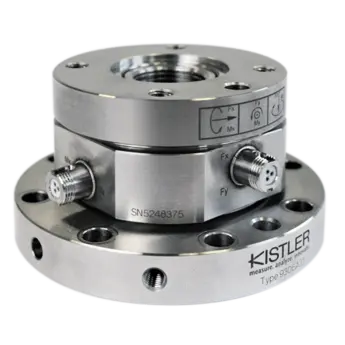
6-axis piezoelectric force-torque sensor (Fx, Fy, Fz, Mx, My, Mz, low profile version)
9306A31
18034697
  • 6-axis force-torque sensor, low profile with measuring ranges Fx, Fy: -1 ... 1 kN, Fz: -2 โ€ฆ 2 kN and Mx, My, Mz: -100 โ€ฆ 100 Nm
  • Connection: 2 x V3 neg.
  • Dimensions: DxH (mm) 83x45
๋ฌธ์˜ ์š”๋ง
๋ฌธ์˜ ์š”๋ง
์š”์ฒญ ์‹œ
Measuring ranges
Minimum measuring range [kN]
-2 kN
Maximum measuring range [kN]
2 kN
Reaction torque range (as vector) Mx, My, Mz
ยฑ100 Nm
Calibrations
Moment calibrated range (force-free)
ยฑ100 Nm
Product type
Measurement system
Sensor
Force sensor type
A dynamometer is a force plate measuring forces and moments.
Piezoelectric 6-Axis force/torque sensor
Preloaded sensor
Preloaded sensors are already calibrated and therefore ready-to-use. Non-preloaded sensors are smaller.
Yes
Mechanical properties
Axial stiffness
5.4 kN/ฮผm
Bending stiffness
16.7 kNยทm/ยฐ
Shear stiffness
1.62 kN/ฮผm
Torsional stiffness
18.6 kNยทm/ยฐ
Lateral stiffness
0.9 kN/ฮผm
Crosstalk
Maximum crosstalk Fxโ†’Fy
-2 โ€ฆ 2 %
Maximum crosstalk Fxโ†’Fz
-4 โ€ฆ 4 %
Maximum crosstalk Fyโ†’Fx
-2 โ€ฆ 2 %
Maximum crosstalk Fyโ†’Fz
-4 โ€ฆ 4 %
Maximum crosstalk Fzโ†’Fx
-2 โ€ฆ 2 %
Maximum crosstalk Fzโ†’Fy
-2 โ€ฆ 2 %
Metrological characteristics
Linearity
Linearity represents the maximum deviation/error between ideal and actual output signal characteristics in relation to the measurand in a specific measuring range. It is expressed in percentage of the range of measurement signal (Full Scale Output).
โ‰คยฑ1.5 %FSO
Linearity including hysteresis
Linearity represents the maximum deviation/error between ideal and actual output signal characteristics in relation to the measurand in a specific measuring range. It is expressed in percentage of the range of measurement signal (Full Scale Output).
โ‰คยฑ1.5 %FSO
Nominal sensitivity [pC/N]
-3.7 pC/N
Threshold Fx
Minimum change in the measurand that produces a measurable change in the sensor output, while the change of the measurand takes place slowly and monotonically.
0.01 N
Threshold Fy
Minimum change in the measurand that produces a measurable change in the sensor output, while the change of the measurand takes place slowly and monotonically.
0.01 N
Threshold Fz
Minimum change in the measurand that produces a measurable change in the sensor output, while the change of the measurand takes place slowly and monotonically.
0.01 N
Threshold My
Minimum change in the measurand that produces a measurable change in the sensor output, while the change of the measurand takes place slowly and monotonically.
0.2 mNยทm
Threshold Mz
Minimum change in the measurand that produces a measurable change in the sensor output, while the change of the measurand takes place slowly and monotonically.
0.2 mNยทm
Threshold (acceleration)
Minimum change in the measurand that produces a measurable change in the sensor output, while the change of the measurand takes place slowly and monotonically.
0.2 g RMS
Electrical properties
Output signal type
Charge (Piezoelectric, PE)
Minimal insulation resistance
10^12 ฮฉ
Ground Insulation
>10^8 ฮฉ
Influence quantities
Reaction torque sensitivity Mx, My
โ‰ˆโ€“265 pC/Nm
Reaction torque sensitivity Mz
โ‰ˆโ€“205 pC/Nm
Dynamical properties
Natural frequency Fx
Frequency of free (not forced) oscillations of the entire sensor. In practice the (usually lower) natural frequency of the entire mounted system governs the frequency behavior.
13 kHz
Natural frequency Fy
Frequency of free (not forced) oscillations of the entire sensor. In practice the (usually lower) natural frequency of the entire mounted system governs the frequency behavior.
13 kHz
Natural frequency Fz
Frequency of free (not forced) oscillations of the entire sensor. In practice the (usually lower) natural frequency of the entire mounted system governs the frequency behavior.
13 kHz
Natural frequency Mx
Frequency of free (not forced) oscillations of the entire sensor. In practice the (usually lower) natural frequency of the entire mounted system governs the frequency behavior.
11 kHz
Natural frequency My
Frequency of free (not forced) oscillations of the entire sensor. In practice the (usually lower) natural frequency of the entire mounted system governs the frequency behavior.
11 kHz
Natural frequency Mz
Frequency of free (not forced) oscillations of the entire sensor. In practice the (usually lower) natural frequency of the entire mounted system governs the frequency behavior.
11 kHz
Certificates and Standards
Degree of protection EN 60529
IP68
Operation and installation
Operating temperature range
-40 โ€ฆ 80 ยฐC
Applications
NVH testing, Space payload testing, 3C electronics manufacturing
Cable properties
Cable included
No cable included
Interfaces
Connector type
V3 neg., V3 neg.
Dimensions and materials
Weight
0.54 kg

This 6-axis force-torque sensor measures all forces and the corresponding moments on the three orthogonal axis. All forces and moments are captured as physical, piezoelectric signals and do not need to be calculated. The unique measurement setup of this multi-axis force-moment sensor allows an extremely small and compact design. Therefore concise models of 3-dimensional dynamic and quasistatic processes are possible even in narrow installations. Pretensioned piezoelectric 6-axis force-torque sensors with two mounting flanges. Measures forces and reaction torques in both tensile and compression directions. A force or reaction torque generates a proportional electrical charge. This is transferred by an electrode to the corresponding connector. The multi-axis force-torque sensor consists of large-area quartz discs and is therefore very rigid. The resulting high natural frequency is a prerequisite for highly dynamic force and torque measurements. The two 3-pole V3 neg. connectors are provided with an antitwist lock. One connector each for force and torque signals. After it has been correctly installed the 6-axis force-torque sensor is immediately ready for use without recalibration.

๋กœ๋”ฉ ์ค‘
๋กœ๋”ฉ ์ค‘