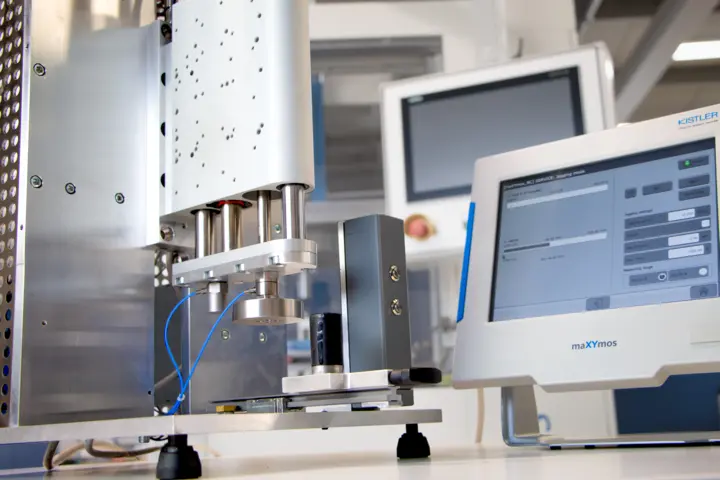
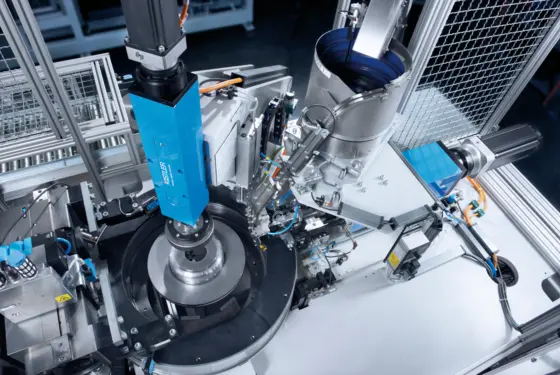
“The demands for highly accurate force measurement combined with high dynamics are constantly increasing. Until now, users had to decide whether to focus on precision and exact process monitoring or on speed. In areas where consistently high quality is crucial, choosing a slower system has traditionally been the only viable option. With our new NCFQ high-speed joining system, there is no need to compromise,” explains Peter Balzer, Product Manager for NC joining systems at Kistler. The first systems are already in use in the pharmaceutical industry. In a production facility for insulin pens, for example, the insulin cartridge is automatically inserted into the plastic housing of the auto-injector and then assembled using the NCFQ joining system. In addition to speed, absolute precision is essential: if the force is too low, the individual parts are not reliably joined; if the force is too high, the cartridge can be damaged and insulin can leak out. Thanks to the reliable measuring and joining technology, the company can be sure that the pens are functional and that potential production errors are eliminated – even at cycle times of 500 milliseconds.
High-speed joining system with automatic acceleration compensation
One major challenge in this process is that the forces acting on the product itself are not the only variables that need to be considered. “Due to the high dynamics of the linear module, the acceleration forces are always measured, too” explains Peter Balzer. “However, they are irrelevant for product quality and make it difficult to evaluate the process based solely on force data. For particularly accurate process monitoring, we therefore offer, in addition to the basic version of the NCFQ high-speed joining system an advanced version. Here, we have integrated an additional highly sensitive 8203A piezoelectric acceleration sensor. It enables the system to automatically filter out the acceleration forces of the joining module and make joining forces only visible. This greatly simplifies process control and evaluation.”
In addition to integration into complete production lines, the system can also be used in process development. In this application, it is already being used as a stand-alone workstation for manual assembly at a pharmaceutical company. Depending on the specific application requirements, the system can also be equipped with alternative sensors and joining modules with different strokes and joining forces. For maximum planning reliability, transparent cost control, and the optimization and validation of joining processes, Kistler’s Assembly Competence Center (ACC) provides support. “The ACC is our central point of contact for determining precise measurement values and process parameters in the production environment. Together with users, we tailor our systems to the specific application so that they meet all requirements for precision, speed, and tool compatibility,” concludes Peter Balzer.
¹NCFQ 2166A high-speed joining system. Joining technology with a unique operating principle – patent pending.
²LinMot is a registered trademark of NTI AG.