Fiber optic sensing solutions for demanding applications

Kistler engineer demonstrating a fiber optic sensing system with real-time measurement data visualization.

Distributed strain, shape and temperature sensing based on fiber segment interferometry (FSI)

Kistler-exclusive fiber segment interferometry, or FSI, brings distributed fiber optic sensing to applications where measurement precision, speed, and spatial insight are critical. It allows engineers to monitor physical changes along the fiber, capturing both static behavior and fast dynamic effects.

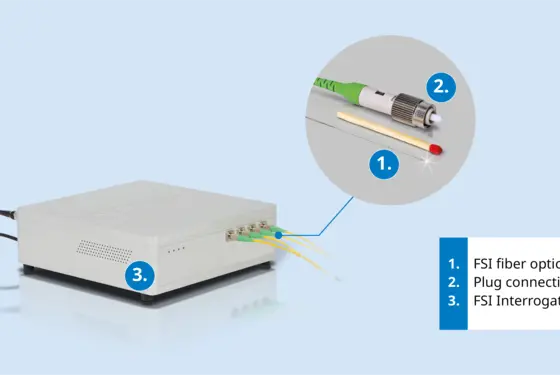
Fiber segment interferometry (FSI) divides the optical fiber into multiple sensing segments using integrated reflectors. The system evaluates each section individually to generate spatially resolved measurement data along the sensing path.

This measurement principle creates a flexible basis for different sensing tasks, especially where conventional electrical sensors provide limited insight or are difficult to apply.

What can be measured with FSI technology?

Depending on the sensor configuration and installation, FSI can be used to measure or derive a broad range of physical parameters along the sensing fiber, including:

[object Object]

Strain

Digital measuring chain

Shape

Thermometer icon

Temperature

[object Object]

Vibration and acceleration

Compress icon

Pressure

Remote firmware update

Torsion

[object Object]

Acoustic emission

[object Object]

Force

Get application-specific guidance

Our experts are just a click away.

Fiber segment interferometry – selected performance data

Values depend on sensor type, sensor configuration, interrogator version, and application setup. The following figures show selected capabilities of FSI-based products.

Typical applications of FSI based fiber optic sensing