Hard turning by Minganti: Kistler supports automated CNC machining with integrated tool monitoring


Hard turning specialist Minganti Global AB and the measurement technology experts from Kistler have developed an integrated tool monitoring solution for Minganti’s M2 machine tool series. The combined force and vibration measurement with piezoelectric sensors enables early tool wear detection, higher part quality and – via a digital charge amplifier directly connected to the machine tool – an increased level of automated CNC machining.

In recent years, hard turning has gained momentum as a cost-efficient and flexible alternative to grinding. Hard turning is a machining process used to finish special materials – such as hardened steels or titanium alloys with hardness values above 45 HRC (Rockwell scale) – directly on a lathe. Instead of relying on grinding, hard turning removes material using geometrically defined cutting edges, most often cubic boron nitride (CBN) or advanced ceramic tools. The process is especially common for rotationally symmetric parts such as shafts, gears, and bearing components, where high dimensional accuracy and excellent surface quality are required.

What makes hard turning particularly demanding is the combination of extreme material hardness, high cutting forces, and elevated temperatures in the cutting zone. While highly productive, hard turning poses significant challenges in maintaining tool life, ensuring consistent part quality, and minimizing downtime. To meet these challenges, advanced tool and process monitoring solutions are required to enable predictive insights, process stability, and autonomous machining.
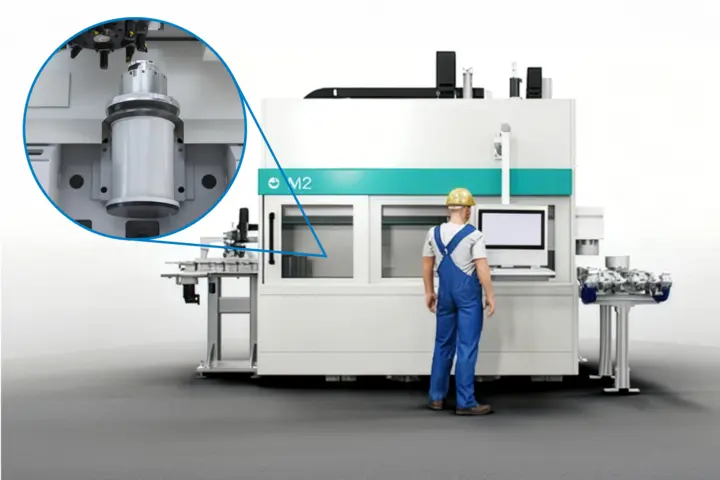
Minganti M2 series: a new machine tool concept for hard turning – a vertical lathe with machine and tool monitoring.
Minganti M2 series: the new machine tool concept for hard turning represents a vertical lathe with integrated machine and tool monitoring from Kistler.

Minganti M2: modular hard turning platform with vertical lathe

Minganti Global AB is a leading manufacturer of high-precision hard turning and superfinishing machine tools, headquartered in Lidköping, Sweden. Established in 1919, the company has been building a global presence, with over 700 machines installed in more than 15 countries for demanding applications in hard turning, superfinishing and combined processes. The platforms from Minganti are engineered in-house and are tailored around customer production needs rather than off-the-shelf templates, focusing on dimensional stability, low surface roughness, and efficient material removal in hardened steels.

In a recent partnership with Kistler, Minganti has developed a new machine and tool monitoring solution for its new M2 vertical lathe machines. The M2 is a modular platform from Minganti that represents hard turning machines engineered for demanding precision finishing of hardened components with tight tolerances and stringent surface requirements. Built around linear drive axes for rapid positioning and accurate feed, M2 combines automatic loading and unloading of parts with intelligent monitoring from Kistler – key for short cycle times and high quality in terms of roundness, cylindricity and surface finish for bearing rings, transmission parts and similar components.

Automated CNC machining with sensor integration

Traditional machining processes often suffer from unplanned downtime, excessive tooling costs, and quality variations. Operators must rely on experience and manual checks to detect tool wear or machine issues, which limits productivity and prevents full automation. Minganti engineers therefore looked for a solution to detect tool wear and process anomalies in real time. Integrated tool monitoring not only would enable consistent part quality despite demanding cutting conditions but also reduce machining cost per part while increasing machine uptime. Not least, it supports automated CNC machining processes and the overall vision of autonomous production.

Cooperating with Kistler, Minganti decided to integrate piezoelectric sensors into the new M2 hard turning machine tool series: The 9102C ring force transducer from Kistler is mounted under the turret bolt (see image) to capture vertical cutting forces up to 60 kN during machining. This piezoelectric force sensor comes with a very low threshold and has a virtually unlimited service life. For vibration measurement, two small and lightweight accelerometers (8274A5) from Kistler are additionally integrated into the machine setup: one on the spindle to detect dynamic behavior and early signs of imbalance or chatter, and the other one on the turret to monitor tool vibrations during machining.

All three sensors continuously capture data, which is transmitted digitally via PROFINET. Machine connection is made with the digital industrial charge amplifier 5074B from Kistler: This universal device for piezoelectric sensor signals allows for a reliable and precise capture of dynamic and quasi-static processes on modern PLC systems – with cycle times down to 100 μs and oversampling up to 50 kSps.

Integrated tool monitoring provides multiple benefits

The new integrated tool wear monitoring solution from Minganti and Kistler works with advanced algorithms and process know-how to transform raw data into actionable insights for tool wear detection and process stability. Thanks to the high sensitivity of the piezoelectric sensors, cutting forces and vibrations at both spindle and revolver can be measured simultaneously. This not only renders the process more intelligent but also improves maintenance work and decreases the risk of unplanned machine down times.
Depending on the tool wear, there will be an obvious change in the cutting forces. In the machine program, relevant limits were defined; when these limits are violated, the machine itself takes the necessary actions – thus enabling automated CNC machining. Regarding part quality during hard turning, the normal force to the machined part is an indication of the profile accuracy achieved. By controlling the deviations in the force signals, an indirect assessment of the profile accuracy can be done. This reduces the effort for additional quality measurements which can be a high cost for bearing manufacturers.

Minganti and Kistler: successful partnership advances hard tuning

To sum up, the described M2 machine tool project has resulted in a robust, intelligent machining solution that combines Minganti’s engineering expertise with Kistler measurement technology and data-driven process knowledge. Benefits of the real-time tool monitoring solution include reduced machining costs, improved part quality (tighter tolerances and more consistent surface finish due to stable processes), higher OEE (overall equipment effectiveness), and more automated CNC machining with less operator intervention.

Marcus Caldana, President of Minganti Global AB, concludes: “This success story marks a significant milestone in our journey towards smart manufacturing and Industrial IOT. By bridging machine design and sensor intelligence, Minganti and Kistler are aiming to set new standards in hard turning automation.”

¿Necesita una consulta?

Nuestros expertos están a un solo clic.