
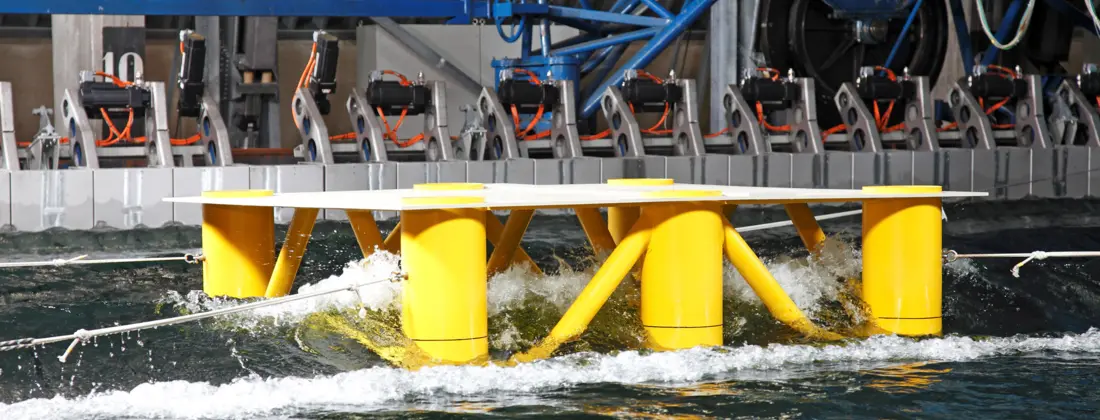
Moving liquids can exert enormous pressure on structures inside and outside ships and on offshore installations such as oil and gas platforms or wind turbines. Reliable measurements of sloshing (LNG movements and cavitation) and slamming (wave impacts) phenomena require application-specific pressure sensors and dynamometers.
Sloshing and slamming testing
Small size
A small front diameter is one of the key requirements for the sensors in this application. Thanks to this configuration, the sensors can be installed as close to one another as possible so as to optimize spatial resolution.Fast rise time
Impact pressures are largely dependent on induced motion. They can range from 50 mbar to 7 bar, with fast rise times of between 1 and 10 ms. These conditions require pressure sensors with fast rise times and/or high natural frequencies.IEPE (voltage)
This application requires a considerable number of sensors, so a cost-effective measuring chain solution is essential. Thanks to IEPE technology, the pressure sensors can be connected directly to the DAQ system with no need for costly charge amplifiers.Low thermal shock
Measured impact pressures may be affected by a pressure sensor's thermal shock behavior. The design of Kistler's 601C series features very low sensitivity to thermal shock, so these sensors are highly suitable for measuring impact pressures due to sloshing.High sensitivity
Expected pressure of less than 1 bar should be measured with the correct accuracy; thanks to IEPE technology, the pressure sensors can be connected directly to the DAQ system with no need for costly charge amplifiers.Low thermal shock
Measured impact pressures may be affected by a pressure sensor's thermal shock behavior. The design of Kistler's 601C series features very low sensitivity to thermal shock, so these sensors are highly suitable for measuring impact pressures due to slamming.Fast rise time
Common impact pressures are below 1 bar with fast rise times of roughly 1 ms. These conditions require pressure sensors with fast rise times and/or high natural frequencies.Rangeability
Piezoelectric technology can handle heavy structures while focusing on the smallest dynamic variations thanks to the right choice of charge amplifier settings.Waterproof force sensors
Force sensors from Kistler are hermetically sealed with a welded design to ensure that they are watertight. Cables are fitted with seals specifically designed for underwater use. Further water tightness can be achieved by welding a 1698A cable on a triaxial force sensor.Featured products

Handheld charge amplifier and transmitter monitor
Data recording, insulation testing and quality assurance – the easy way
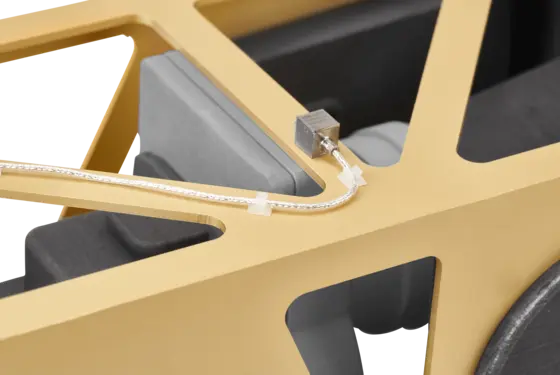
KiVibe Miniature triaxial IEPE accelerometer
The perfect fit for vibration measurements on lightweight structures and in tight spaces
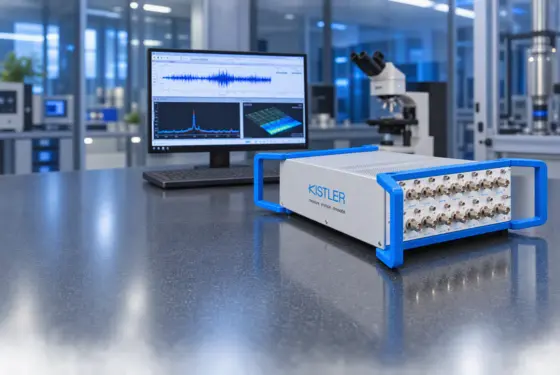
KiBox Lab 5280A – Multi-channel charge amplifier and DAQ
High-end signal conditioning and data acquisition for demanding application
