
Kontrola dynamiki pojazdu: firma Kistler przedstawia czujnik wektorowy koła o jeszcze większej dokładności
Winterthur, luty 2026 r. – Nowa wersja czujnika wektorowego koła RV-5 firmy Kistler rejestruje ruchy koła w pięciu osiach (kąt skrętu, kąt pochylenia kół oraz ruchy w kierunkach X, Y i Z) z jeszcze większą dokładnością i niezawodnością. Dzięki innowacyjnej elektronice z enkoderami magnetycznymi czujnik zapewnia wyższą jakość pomiarów kół, np. do kontroli dynamiki pojazdu. Pozostaje w pełni kompatybilny z poprzednim modelem, RV-4.
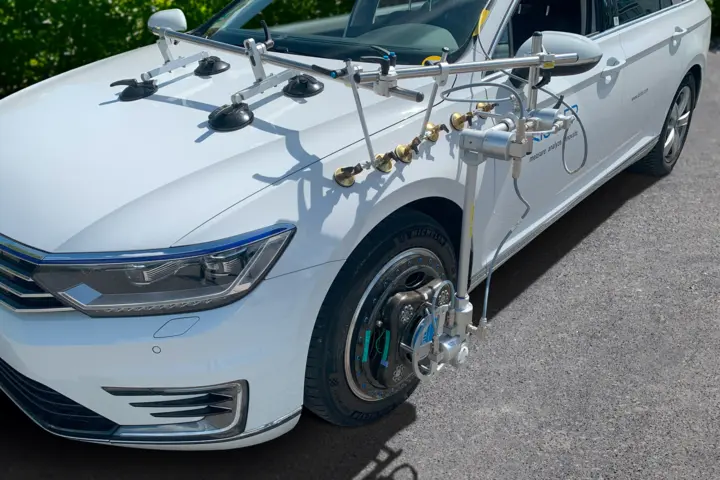


Efficiently measure wheel position, steering angle, and camber angle
The new generation RV-5 wheel vector sensor from Kistler delivers such measurements with even greater robustness and accuracy. The heart of the sensor, consisting of several encoders and electronics, has been completely redesigned. Magnetic encoders replace the previous optical encoders, contributing to higher signal quality and resolution, lower noise, and more robust measurements. The RV-5 remains fully drop-in compatible with its predecessor, the RV-4: installation, operation, and interfaces remain unchanged.
Robust and stable under all driving conditions
The RV-5 connects directly to the wheel carrier structure and measures the wheel vectors at the source – without a necessary line of sight, without image processing, without dependence on surface textures or markers. Consequently, measurements remain stable and reproducible in rain, dust, splash water, or abrupt changes in light, even if the wheels are partially or completely covered by fairings and in the wheel arch. The factory calibration in the vehicle coordinate system remains stable across temperature and vibration changes; recalibrations, as required with camera-based setups, are not necessary.
At the same time, the RV-5 wheel vector sensor from Kistler is insensitive to optical artifacts and remains reliable even on rough roads, curbs, and under high lateral and vertical accelerations. The mechanical kinematics with magnetic encoders deliver consistent, high-precision, and low-latency data even where camera- and optics-based approaches reach their physical and practical limits.
Magnetic encoder: higher linearity, stability and resolution
The new magnetic encoders in the RV-5 ensure significantly better signal quality: thanks to higher linearity and stability, they deliver clean data across the entire working range – even during dynamic load changes. At the same time, they offer higher resolution, allowing even the slightest changes in angle and displacement to be captured. The lower sensor noise also results in significantly smoother raw signals that require less filtering and are available with lower latency.
The new wheel vector sensor from Kistler integrates seamlessly into existing setups: Setup is carried out as usual using the KiCenter software, so that established test procedures, scripts, and evaluations can continue to run unchanged. Mixed setups consisting of RV-5 (magnetic encoders) and RV-4 (optical encoders) are also possible. Kistler also offers service upgrades for existing RV-4 sensors, which can be converted to magnetic encoder technology.
The new RV-5 is now available in versions for passenger cars and trucks. In addition, the wheel vector sensor can be ordered separately, with evaluation electronics, or with a wheel pulse generator (WPT, which also provides the lateral wheel angle and wheel speed). Oliver Plenter, Business Development Manager at Kistler, says: “Magnetic encoders make our wheel vector sensors even more robust and precise without disrupting customers' established setups. Plug in, configure, measure – everything as usual, but with even higher quality.”

![[object Object]](https://kistler.cdn.celum.cloud/SAPCommerce_Document_Preview/999-351e.webp "Peak performance in wheel measurement")