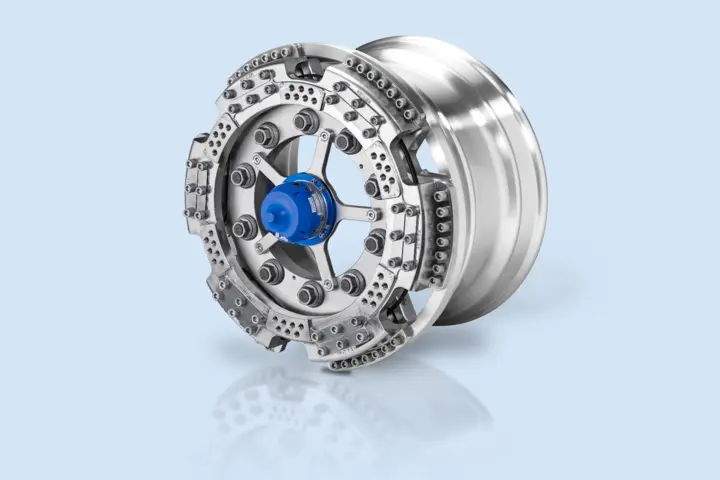
Existing wheel torque transducers can be upgraded thanks to their modular design
The further development of the RoaDyn P1ST/MT/HT wheel torque transducers has been designed so that existing torque wheels can be upgraded with the new components. Users can rely on maximum compatibility. Existing customers do not need to replace the entire wheel force transducer. The load cells currently installed will simply be replaced with the new components and optimized cabling; no reconfiguration is required. Kistler offers its customers the upgrade as a special service, thereby ensuring maximum sustainability and investment protection. A less complex design not only increases reliability and service life, customers also benefit from lower costs compared to a completely new investment. Effective immediately, only the advanced technology will be used.
Focusing on rolling resistance measurements according to the EU CO₂ Emission Regulation
In addition to typical applications such as research and development in the field of dynamic control systems, determining powertrain efficiency, measuring vehicle performance or analyzing fading effects in brakes, the wheel torque transducer is a key component in determining the CO₂ emissions of light, medium and heavy-duty commercial vehicles. Since 2025, stricter guideline values have applied to commercial vehicles over 3.5 tons on the basis of the EU’s CO₂ Emissions Regulation, which will be further tightened in a next step in 2030. To determine the CO₂ emissions, measured values for air resistance (Cd x A), the rolling resistance coefficient (RRC), engine performance maps, transmission and powertrain characteristics as well as axle and rotational inertia are recorded.
Within these measurements, the determination of the operating loads of a vehicle acting on a wheel torque transducer such as the RoaDyn P1ST/MT/HT while driving is of great importance. Finally, the CO₂ emissions are calculated from the measured values using the EU's standardized "VECTO" (Vehicle Energy Consumption Calculation Tool) calculation model. Manufacturers have a strong interest in component testing, as the precise measurements often yield values that exceed the standard values that would otherwise be used. The RoaDyn P1ST/MT/HT wheel torque transducers are the manufacturers' preferred choice for these mandatory tests. In contrast to other technological approaches, they do not require complex brackets on the outside of the vehicle body, which also increase the flow resistance of the vehicles and can lead to a falsification of the measurement results.
Measuring traction torque via telemetric signal transmission
Like all torque wheels of the flexible P1 series, the RoaDyn P1ST/MT/HT wheel torque transducers are quick and easy to install and can be replaced if necessary. The respective torque wheel replaces the center section of the rim, which is the most effective position for recording torques and at the same time offers optimum integration in the vehicle's chassis system. The traction torque My is measured using piezoelectric quartz sensors. The electronics integrated in the wheel torque transducer amplify and process the signals. In addition, these torque wheels each have four channels for temperature measuring elements. The data is transmitted wirelessly using the KiRoad Wireless P1 data transmission system, the receiver of which can be positioned inside the vehicle. For further processing, this system can be connected to the KiDAQ from Kistler or any data acquisition system (DAQ system) from other manufacturers. The new RoaDyn P1 series wheel torque transducers are extremely versatile and indispensable for research and development, certification and testing.
Patented technology
Kistler holds a patent for the piezoelectric precision load cell for determining torques on wheels. Among other things, this further development means that this patented load cell delivers even more reliable, high-precision results thanks to the greatest possible protection and technical simplification.