
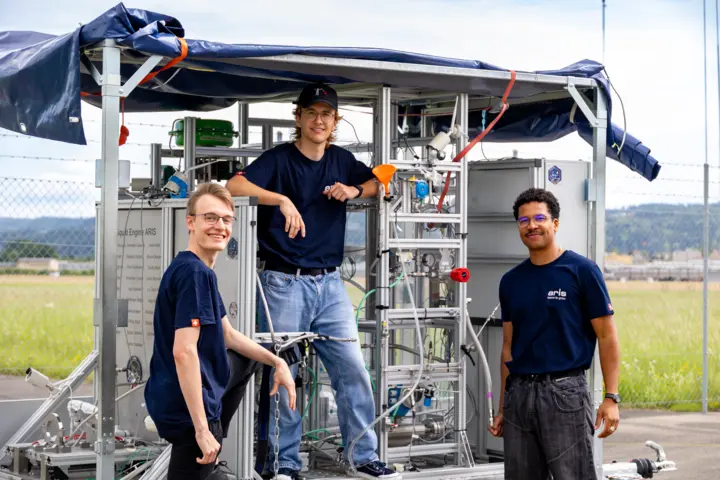
Thomas Ebnöther, Noah Giger, Simi Wespi, and the entire Perseus team have successfully accomplished a journey that was far from easy. These students (from ETH Zurich and the Eastern Switzerland University of Applied Sciences (OST)) were driven by the idea of building a revolutionary rocket engine. But at the outset, they had to accept a bitter setback: in spring 2024, their application for the award of a focus project was initially rejected – as “too complex, too dangerous, and too expensive.” However, giving up was not an option, so they managed to convince ARIS to take them on as a special project. ARIS is the German acronym for the ‘Academic Space Initiative Switzerland’. Set up in 2017 by ETH Zurich, this organization now brings together over 400 students who tackle challenging projects in the fields of rocket construction, robotics, and satellite technology. These include, for example, an unmanned underwater vehicle that can be used in marine and climate research – and even for extraterrestrial applications such as exploring the icy oceans of Saturn's moon Enceladus. And since October 2021, Kistler has also been on board as a main sponsor, providing appropriate measurement technology to support successes such as the Swiss altitude record achieved by the ARIS HELVETIA rocket.
ARIS Perseus achieves proof of concept for RDRE – with Kistler measurement technology
In less than one year, Swiss mechanical engineering students have succeeded in building and firing a rotating detonation rocket engine (RDRE). Kistler measurement technology for short-term dynamics shows the presence of detonation waves that are characteristic of an RDRE. This major success for ARIS Perseus was achieved in the face of considerable opposition – but now, planning is already under way for the next steps.


The journey to the rocket engine of the future
ARIS Perseus is named after the ancient Greek hero who became proverbial for his perseverance. It was launched as a special project under exceptionally difficult conditions: no recognition as an academic achievement ( no ECTS credits), just CHF 1,000 as startup capital, and – to add to the challenges – a very tight time frame. “The LRE (Liquid Rocket Engine) trailer was essential for the tests – this is a mobile test bench with the necessary technical equipment. But it was already firmly booked for another ARIS project in December 2024,” as Simi Wespi, founder and project manager of ARIS Perseus, recalls.
Faced with this difficult situation, the ‘Perseids’ decided to make use of a paper by American scientists that Thomas Ebnöther had studied in depth for his Bachelor's thesis. “With that approach, we were able to make the whole project comprehensible and plannable,” Wespi recalls. The goal: to build a rotating detonation rocket engine (RDRE) with severely limited resources, and to fire it until a steady state could be achieved. “Fortunately, we soon found the sponsors we needed. Little by little, we managed to convince people within ARIS as well, and we fought hard to obtain regular project status,” Wespi reports proudly.
Kistler measurement technology – critical for proof of concept
However, there was a long way to go before the goal was reached. An RDRE is certainly viewed as a very promising approach with potentially high efficiency gains. However, controlling the combustion process is far from easy due to the detonation waves that propagate at supersonic speeds. “This phenomenon was discovered during the construction of the Saturn V rocket in the 1960s,” says Sebastian Nobs, a member of the ARIS Perseus Engine Team. “Back then, the aim was to prevent the supersonic detonation waves by constructive means – and that was also achieved. But at some point, someone came up with the idea of letting them run in a circle to take advantage of the high pressures.”
The ‘Perseids’ took the theoretical design as the basis for building their rocket engine, which consists mainly of an annulus (ring-shaped space) with inlets for fuel and oxidizer. The gas mixture is ignited by a component known as the pre-detonator, via a bore on the top. “It then takes about 0.6 seconds to reach a dynamically stable state,” Wespi explains. “For that reason, we decided to fire for one second so we could measure and record the detonation waves, and thus provide the proof of concept.” ARIS Perseus uses 601CAA pressure sensors from Kistler to measure the detonation waves. Thanks to their natural frequency of 215 kHz, these sensors are capable of accurately recording the highly dynamic processes in the combustion chamber at about 20 kHz. Data acquisition also requires a transient recorder for short-term dynamics that is able to capture and record the sensor signals at high frequencies. The device used in this case is the 2529A, developed in a collaboration between Elsys and Kistler, for highly dynamic charge, voltage, and IEPE signals with frequencies of up to 500 kHz.
The charts (see image below) show the different RDRE pressure profiles for deflagration (irregular) and detonation (regular). The stable pattern of a detonation (reached after about 0.6 seconds) was recorded by the two Kistler pressure sensors mounted at a 90° angle – and so proof of concept was successfully obtained. Nicolas Bartzsch, responsible for electronics and sensor technology (DACS – Data Acquisition and Control Systems) at ARIS Perseus, reports: “The measurement technology from Kistler worked perfectly and was very well documented. We were also able to count on personal support if we had any questions or problems – and that was especially helpful. One of the many issues we faced was the need to prevent excessive thermal shock by protecting the pressure sensors from the flame front with spacer rings and silicone paste.”
The goal: to fire the RDRE for longer and use it as a real rocket engine
However, that was not the only challenge to be overcome by the team – which had now grown from three to eleven people. The mobile test bench was designed for liquid fuels, but it had to be converted because oxygen and methane in gaseous form were used for the ARIS Perseus RDRE. Most important of all, however, was the safety concept: success could only be guaranteed by meticulous planning, very precisely defined roles and responsibilities, and compliance with numerous regulations (regarding gas velocities, minimum distances, and more). “Without the appropriate manpower and pages of protocols and documentation, nothing whatsoever is possible,” Wespi explains. “In the end, we were allowed to test not only at the ETH Zurich Hangar on the Dübendorf military airfield, but even on the publicly accessible Innovation Park Zurich (IPZ) site as well.”
The successful outcome proves that the students – some of whom even worked full-time on the project – were right: Pegasus, the follow-up project, has already been accepted by ETH Zurich, and the new team is now in place. After switching to liquid fuels, the plan is then to fire a rotating detonation rocket engine for eight seconds, achieving at least 1 kN of thrust. Wespi continues: “This will require water cooling as well as pressure and temperature sensors. We’ve had very good experiences with measurement technology from Kistler, and we’re glad to make use of it again.” And practical use of the innovative rocket engine is already on the horizon. In ‘Andromeda’, another possible ARIS project, the students will set their sights on an RDRE-powered rocket that should reach a flight altitude of three kilometers – which would be one more spectacular world record for a student team!

![[object Object]](https://kistler.cdn.celum.cloud/SAPCommerce_Document_Preview/962-098e.webp "Successful Proof of Concept for Rotating Detonation Rocket Engine (RDRE)")