
Controllo della dinamica del veicolo: Kistler presenta un sensore vettoriale per ruote con una precisione ancora maggiore
Winterthur, febbraio 2026 – La nuova versione RV-5 del sensore vettoriale per ruote di Kistler rileva i movimenti delle ruote su cinque assi (angolo di sterzata, angolo di campanatura e movimenti nelle direzioni X, Y e Z) con una precisione ancora maggiore e una maggiore robustezza. Grazie a un'elettronica innovativa con encoder magnetici, il sensore offre una misurazione delle ruote di qualità superiore, ad esempio per il controllo della dinamica del veicolo. Rimane pienamente compatibile con il suo predecessore, l'RV-4.
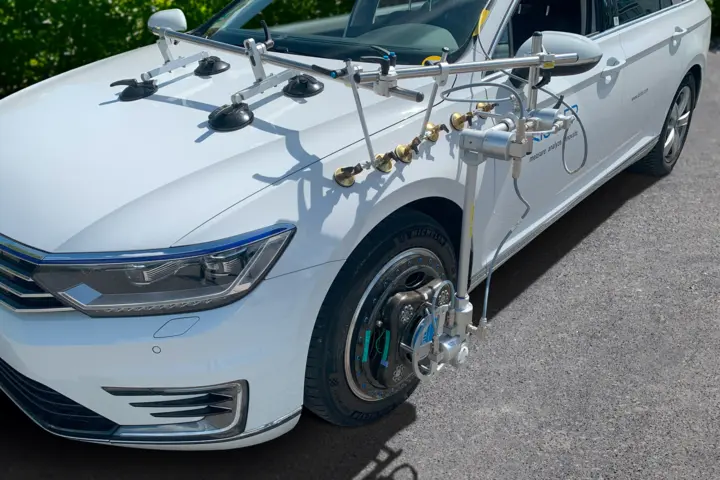


Misura in modo efficiente la posizione delle ruote, l'angolo di sterzata e l'angolo di campanatura
Il sensore vettoriale per ruote RV-5 di nuova generazione di Kistler fornisce tali misurazioni con una robustezza e una precisione ancora maggiori. Il cuore del sensore, costituito da diversi encoder e componenti elettronici, è stato completamente riprogettato. Gli encoder magnetici sostituiscono i precedenti encoder ottici, contribuendo a una maggiore qualità del segnale e risoluzione, a un rumore ridotto e a misurazioni più affidabili. L'RV-5 rimane pienamente compatibile con il suo predecessore, l'RV-4: installazione, funzionamento e interfacce rimangono invariati.
Robusto e stabile in tutte le condizioni di guida
L'RV-5 si collega direttamente alla struttura del supporto ruota e misura i vettori ruota alla fonte – senza necessità di linea di vista, senza elaborazione delle immagini, senza dipendere dalle texture della superficie o da marcatori. Di conseguenza, le misurazioni rimangono stabili e riproducibili in presenza di pioggia, polvere, spruzzi d'acqua o cambiamenti improvvisi di luce, anche se le ruote sono parzialmente o completamente coperte da carenature e nel passaruota. La calibrazione di fabbrica nel sistema di coordinate del veicolo rimane stabile nonostante i cambiamenti di temperatura e le vibrazioni; non sono necessarie ricalibrazioni, come invece richiesto nelle configurazioni basate su telecamera.
Allo stesso tempo, il sensore vettoriale delle ruote RV-5 di Kistler è insensibile agli artefatti ottici e rimane affidabile anche su strade sconnesse, cordoli e in presenza di elevate accelerazioni laterali e verticali. La cinematica meccanica con encoder magnetici fornisce dati coerenti, ad alta precisione e a bassa latenza anche laddove gli approcci basati su telecamere e ottiche raggiungono i loro limiti fisici e pratici.
Encoder magnetico: maggiore linearità, stabilità e risoluzione
I nuovi encoder magnetici dell'RV-5 garantiscono una qualità del segnale significativamente migliore: grazie alla maggiore linearità e stabilità, forniscono dati puliti su tutto il campo di lavoro – anche durante variazioni dinamiche del carico. Allo stesso tempo, offrono una risoluzione più elevata, consentendo di rilevare anche le più lievi variazioni di angolo e spostamento. Il rumore del sensore più basso si traduce inoltre in segnali grezzi significativamente più uniformi che richiedono meno filtraggio e sono disponibili con una minore latenza.
Il nuovo sensore vettoriale ruota di Kistler si integra perfettamente nelle configurazioni esistenti: la configurazione viene eseguita come di consueto utilizzando il software KiCenter, in modo che le procedure di prova, gli script e le valutazioni consolidate possano continuare a funzionare senza modifiche. Sono possibili anche configurazioni miste composte da RV-5 (encoder magnetici) e RV-4 (encoder ottici). Kistler offre inoltre aggiornamenti di servizio per i sensori RV-4 esistenti, che possono essere convertiti alla tecnologia degli encoder magnetici.
Il nuovo RV-5 è ora disponibile in versioni per autovetture e autocarri. Inoltre, il sensore vettoriale ruota può essere ordinato separatamente, con l’elettronica di valutazione o con un generatore di impulsi ruota (WPT, che fornisce anche l’angolo laterale della ruota e la velocità della ruota). Oliver Plenter, Business Development Manager di Kistler, afferma: “Gli encoder magnetici rendono i nostri sensori vettoriali ruota ancora più robusti e precisi senza interferire con le configurazioni consolidate dei clienti. Collegare, configurare, misurare: tutto come al solito, ma con una qualità ancora superiore.”

![[object Object]](https://kistler.cdn.celum.cloud/SAPCommerce_Document_Preview/999-351e.webp "Peak performance in wheel measurement")