
Sustainability is measurable

Sustainability and Corporate Responsibility

Sustainability report

This is the only world we have. It is our responsibility to make sure it is a place worth living in for future generations too. And so, as far as Kistler is concerned, sustainable practices are not simply a trend. They are part of our identity.

Using our measurement technology solutions, we help customers around the world streamline their processes, save resources, and reduce emissions. At the same time, we take responsibility for our own business activities and are constantly working to reduce our environmental impact.

We view sustainability as an ongoing process of development. Transparency, reliable data, and measurable progress form the basis for our actions. Our mission is to systematically identify the key ESG issues in our business activities, make progress measurable, and identify opportunities for improvement on the basis of data. After all, we can only improve things in a targeted way if we can measure them.

1,799 metric tons

Total CO₂ emissions of
the Kistler Group in 2025

48 percent

CO₂ emissions saved in 2025
compared to base year 2021

27 percent

Global fleet and service vehicles
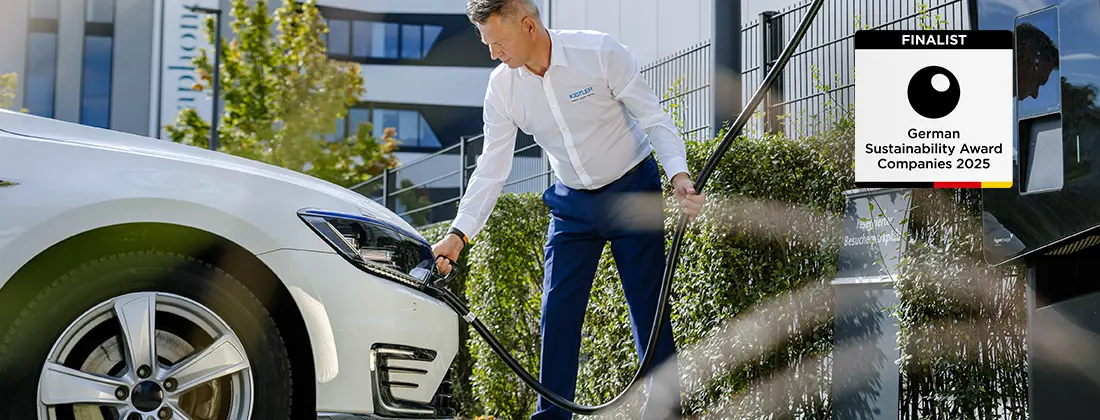
running fully electric

Methodology and transparency

We believe that sustainability can only be managed effectively if it is both measurable and transparent. That is why we systematically track the key indicators relating of our sustainability performance and regularly report on our progress.

Our sustainability reporting is consolidated for the Kistler Group and is based on the Voluntary Sustainability Reporting Standard for SMEs (VSME). The sustainability report is published every two years and is structured according to the ESG dimensions of Environment, Social, and Governance.

Our sustainability strategy is based on a materiality analysis. Based on this analysis, we updated the United Nations Sustainable Development Goals (SDGs) in accordance with the expectations of internal and external stakeholders. As a result, twelve key sustainability issues were identified that Kistler can influence through its business activities. These include, but are not limited to, climate protection, resource efficiency, renewable energies, sustainable product development, alternative mobility, diversity, employee advancement, social engagement, and responsible corporate governance. 

Unless otherwise stated, the climate indicators presented on this website refer to Scope 1 and Scope 2 emissions as defined by the Greenhouse Gas Protocol (GHG Protocol). The year 2021 serves as the base year for our climate goals. Since 2022, we have also been tracking key Scope 3 emissions in order to continuously increase transparency across our value chain and to identify further opportunities for reducing emissions. 

To ensure consistent standards, we are continuously developing our integrated management system. All of the Kistler Group’s development and production sites, as well as selected service and sales subsidiaries, are certified in accordance with ISO 9001. Furthermore, the Winterthur, Lorch, Sindelfingen, and Kistler Nordic sites are certified to ISO 14001 for environmental management. The Winterthur and Lorch locations are also certified in accordance with ISO 45001 for occupational health and safety. 

In addition, we verify the quality and comparability of our climate data by participating annually in the Carbon Disclosure Project (CDP). The independent nonprofit organization evaluates companies using standardized data regarding greenhouse gas emissions, climate risks, and reduction targets and strategies. In the 2024 reporting year, Kistler once again achieved a C rating (“Awareness”). The results provide important insights for further developing our activities, particularly with regard to the value chain, industry collaborations, and emissions reduction. 

In the future, we intend to collect and analyze data on our employees’ commuting habits and on waste and water flows even more systematically. Doing so will enable us to create a more comprehensive database to better understand environmental impacts, measure progress, and identify specific measures for further improvement.

Climate goals and progress

We are making ongoing efforts to reduce the greenhouse gas emissions caused by our business activities. Measurable goals and regular monitoring of our emissions data form the basis for these efforts. 2021 is the base year here.

  • By 2030, we aim to reduce group-wide Scope 1 and Scope 2 emissions by 50 percent compared to the base year 2021.
  • At the same time, we are working toward the goal of making production at our German sites carbon-neutral by 2030.
  • For the entire Kistler Group, our goal is to achieve CO₂ neutrality by 2035. The primary way to achieve these goals is by reducing greenhouse gas emissions.

Progress, as well as the underlying methods and assumptions, is presented in a transparent way in our sustainability report. Unless otherwise stated, all environmental and climate metrics presented on this website refer to the Kistler Group and the respective reporting period indicated. For more information on methodology, system boundaries, and definitions, please see the “Methodology and transparency” section as well as our sustainability report.

The climate targets stated refer to Scope 1 and Scope 2 emissions as defined by the Greenhouse Gas Protocol (GHG Protocol). Net-zero CO₂ emissions are achieved through a combination of emission reductions and, where necessary, remaining offset measures. Direct emission reductions take priority.

In this interview, Franziska Kunz, Head of Global ESG and Sustainability at the Kistler Group, explains how these goals will be achieved and other measures Kistler is taking in the area of sustainability:

Franziska Kunz, Head of Global ESG and Sustainability of the Kistler Group
How does Kistler plan to achieve its goals, and what is the current situation?

During the 2024/25 reporting year, we continued to systematically expand our sustainability initiatives. One area that we focused on was environmental and climate matters, as our business operations have significant environmental impacts in this area. Our focus was on implementing measures to increase energy and resource efficiency, making investments in modern production and infrastructure facilities, and further developing sustainable mobility models. In addition, all sites procure energy products with certificates of origin from renewable energy sources. This improves the market-based greenhouse gas footprint of our power consumption. At the same time, reducing actual energy consumption remains a key component of our climate strategy.

Franziska Kunz, Head of Global ESG and Sustainability

Find out more about our measures and projects in the area of sustainability

Added value for customers and partners

Added value for the environment and the climate

Mobility

Business travel and work-related travel account for a significant proportion of the environmental impacts of our business operations. That is why we are constantly developing our mobility services and gathering data to implement future improvements.

Energy and infrastructure

Reducing greenhouse gas emissions and using resources responsibly are important features of our sustainability efforts. That is why we continuously invest in the further development of our sites, the use of renewable energy, as well as measures to improve energy and resource efficiency. The following examples illustrate how we are gradually developing energy supply, buildings, and infrastructure, relying on transparent data and measures that are effective in the long term.

Circular economy and resources

Conserving resources doesn’t start at the end of the product life cycle. By reusing and modernizing existing systems and extending the useful life of equipment, materials and raw materials can be kept in the cycle for longer.

Added value for people and society

Committed to social and community causes

Acting responsibly and promoting social and community cohesion are important to us: Through initiatives and partnerships, as well as in-kind and financial donations, the Kistler Group supports selected individuals and institutions – and in fact has been supporting many of them for years.

Note on environmental and climate data

Environmental and climate information contained on this website is based on the data and calculation methods available as of the reporting date. Unless otherwise specified, statements regarding emissions refer to Scope 1 and Scope 2 emissions as defined by the Greenhouse Gas Protocol. Prospective statements, goals, and forecasts are subject to change and may differ from actual results.

Downloads

Brochure
[object Object]
Kistler Group Sustainability Report
English
pdf