
New Space is a business and technology field that has emerged over the last 15 to 20 years. Thanks to innovative rocketry and the industrial production of space equipment, payload rates and overall costs for space launches have dropped dramatically – by about a factor of 20. Consequently, many new players are entering this market. Programs and competitions start as early as the university level, such as the European Rocketry Challenge (EuRoC) in Portugal. Since 2020, many student teams from all over Europe have competed year after year in different categories, such as Design, Flight, and Payload, with their sounding rockets.
Faraday Rocketry successfully uses Kistler measurement technology for rocket engine testing
A Spanish student team has achieved success after success with their sounding rockets. After two award-winning performances at the European Rocketry Challenge, the Valencia-based organization set an ambitious goal of reaching outer space. In partnership with Kistler, Faraday Rocketry is developing its own rocket engines, including propulsion testing, vibration testing, and static fire testing.
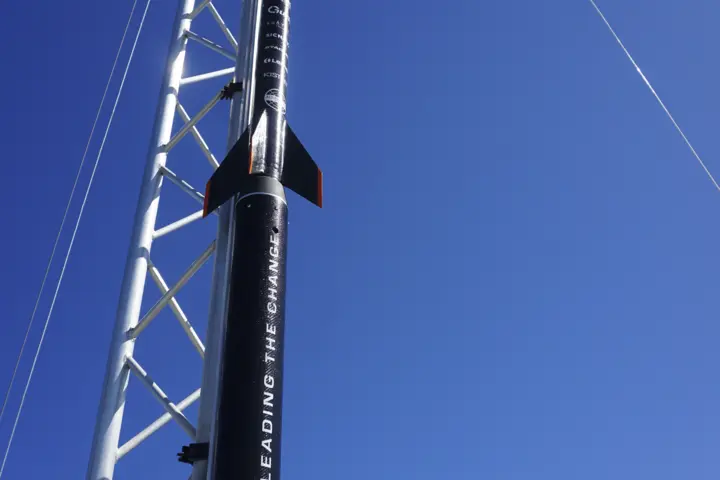


Origin, Faraday Rocketry's rocket that reached 10,843 m and broke the national record, standing in the launch rail just moments before the launch.
From successful sounding rockets to aiming for outer space
One such team is Faraday Rocketry UPV from Valencia. Since its establishment at the Universitat Politècnica de València in 2021, the team has developed five sounding rockets: Aspera, Astra, Genesis (which won a Flight Award at EuRoC 2023), Skybreaker (which won another Flight Award in 2025), and Origin, which has been its most ambitious project: a two stage rocket that broke the Spanish national record of apogee, achieving the astonishing altitude of 10,843 meters in its second launch. With Origin, the team has kicked off the pursuit of a clear goal: to reach the Kármán line, which is 100 kilometers above sea level and is widely accepted as the frontier between Earth and outer space.
"The team's vision is that Europe has the potential to compete in the new space race, and we are the generation with the will and ability to make it happen," said Alberto Pérez, one of Faraday Rocketry's Chief Propulsion engineers. More than 60 students from eight different departments, ranging from avionics to manufacturing to marketing, are engaged in the university team. Measurement experts from Kistler have been partners since the beginning, and Faraday Rocketry has successfully used Kistler equipment, especially for challenging static fire tests.
Rocket propulsion testing including static fire testing
A reliable and robust propulsion system is essential for a successful rocket launch. The Propulsion Department at Faraday Rocketry plays a critical role in this regard, ensuring that the rocket engine meets the necessary thrust and total impulse requirements without affecting other components. This includes maintaining vibrational compatibility with elements such as the airframe and avionics bay, respecting weight limits, and performing these tasks without thermally compromising the rocket.
Álvaro Teijeiro, the second Chief Propulsion engineer, reports: "In the early years, Faraday Rocketry relied on commercial off-the-shelf (COTS) rocket engines. These components were purchased from specialized manufacturers, providing an economical and reliable solution for our needs.” As the team grew, so did its propulsion requirements and ambitions. Thus, the department began a project to upgrade its knowledge and capabilities by developing a student-researched-and-developed (SRAD) rocket engine – designed, manufactured, tested, and validated by the team itself.
Testing equipment from Kistler plays crucial role
When discussing the performance statistics of a rocket engine, thrust, impulse, and internal engine pressure are some of the most important parameters. Accurate and reliable measurement of these magnitudes is essential when performing a static fire test. “Thanks to Kistler, the propulsion department can measure and quantify these values with the utmost accuracy. We use three different piezoelectric sensor technologies for static fire testing: a force sensor, a pressure sensor, and an acceleration sensor,” Álvaro explains.
The 9103C piezoelectric force sensor measures thrust and engine combustion duration. “This allows us to determine how the propellant, the nozzle, and the entire propulsion system behave, thereby validating previous simulations and the rocket engine itself. Furthermore, two of the engine’s most important metrics are derived from measuring thrust over time: total impulse, which indicates how much useful energy the rocket engine generates, and specific impulse, which serves as an efficiency metric by showing how much energy the engine produces per unit of mass of propellant.”
A 603CAA pressure sensor from Kistler measures the pressure in the rocket engine's combustion chamber. Precise measurement of the internal pressure allows the Faraday Rocketry team to ensure the engine operates within expected pressure limits, guaranteeing its overall safety. Finally, the 8702B accelerometer measures radial accelerations caused by combustion in a simple, straightforward way. This information is vital to ensuring vibrational compatibility with the overall rocket structure.
Reliable rocket engine testing as a basis for further successes
Faraday Rocketry, a student-run rocket team, faces many challenges on its way to outer space. Their Origin rocket was successfully launched for the first time in February 2026, reaching an apogee of 4,057 meters above sea level, and set a new Spanish record of 10,843 meters in May. Alberto concludes, "Thanks to Kistler's strong personal support, especially in our early years, we were finally able to perform consistent static fire tests. These tests provided us with crucial data for our project. Faraday Rocketry is therefore very grateful for the partnership with Kistler and relies on its equipment for our journey to space."
Need a consultation?
Our experts are just a click away.

![[object Object]](https://kistler.cdn.celum.cloud/SAPCommerce_Document_Preview/962-183e.webp "Faraday Rocketry successfully uses Kistler measurement technology for rocket engine testing")