
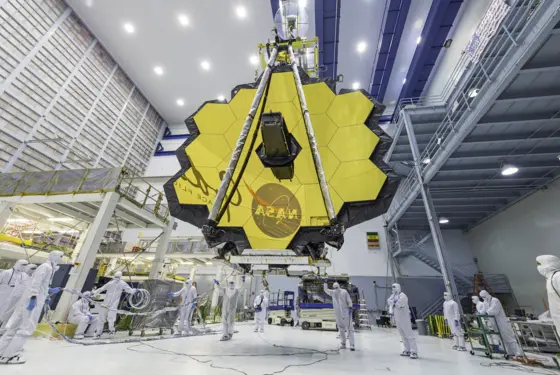
Large payloads which are designated for operation in space – such as satellites and telescopes for example – have to undergo extensive tests before launch: both vibration testing (environmental and force limited) and cryogenic testing procedures require application-specific force sensors and accelerometers which are up to the test.
Space payload testing
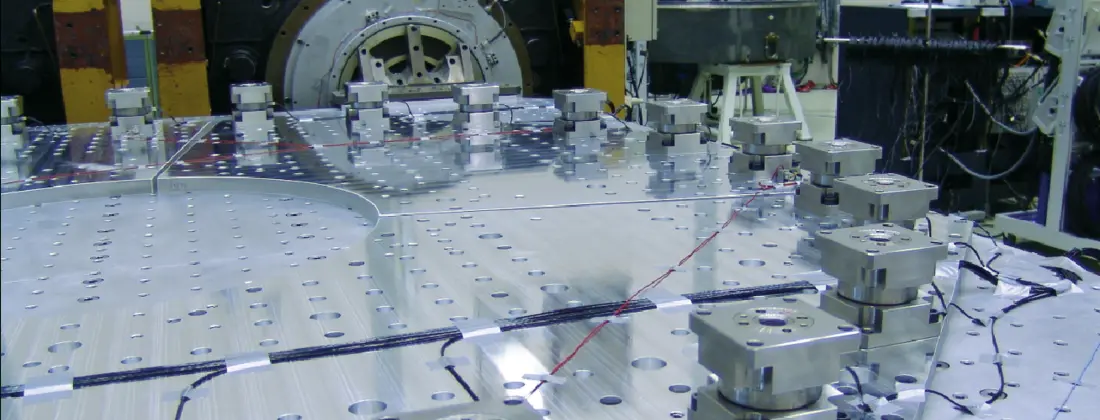
Low-mass and lightweight triaxial accelerometers
Spacecraft structures are often made of thin, lightweight materials, so they require low-mass accelerometers sometimes with a mass lower than 1 gram.Low outgassing cabling solution
Hermetically sealed sensors and low-outgassing cabling solutions from Kistler are sometimes authorized for use in thermal vacuum chambers, or they may even be left on the satellite for launch.Low noise solutions for environmental testing with micro-vibrations
Sensor thresholds ranging from very low (100 μg) to the higher g levels. With Kistler's low noise solutions, the same sensor can be used for the entire range.High resolution
Accelerometers from Kistler detect background vibrations in the micro-vibration range.Cryogenic capability
Charge output sensors or voltage mode IEPE accelerometers feature an outstanding temperature range from below the typical -54°C (-65°F) down to -196°C (-320°F).Low outgassing sensors and cables
Exposure to the high vacuum level of a space environment induces material outgassing that releases entrapped gas. Hermetically sealed sensors and low-outgassing cables from Kistler are designed to meet all needs ideally.Sensitivity deviation less than 1 %
Our PiezoStar-based IEPE (voltage mode) accelerometers are the ideal sensors for precision vibration testing thanks high temperature stability.Featured products

Handheld charge amplifier and transmitter monitor
Data recording, insulation testing and quality assurance – the easy way
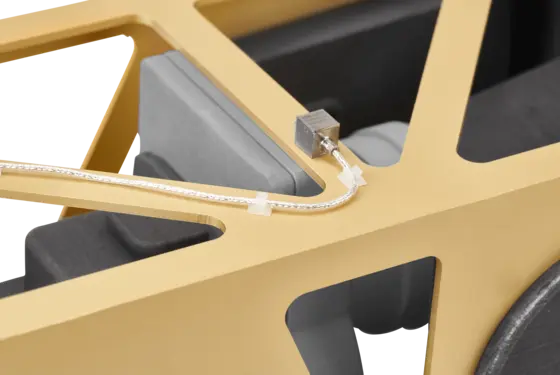
KiVibe Miniature triaxial IEPE accelerometer
The perfect fit for vibration measurements on lightweight structures and in tight spaces
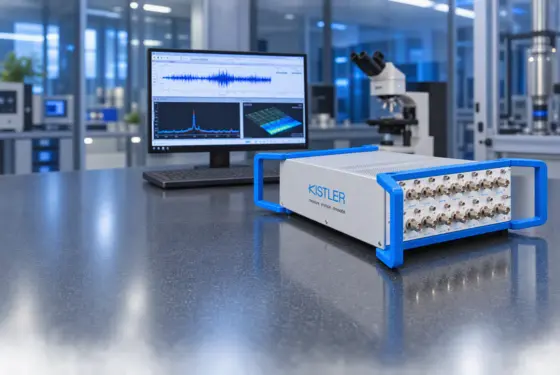
KiBox Lab 5280A – Multi-channel charge amplifier and DAQ
High-end signal conditioning and data acquisition for demanding application
Learn more in our glossary
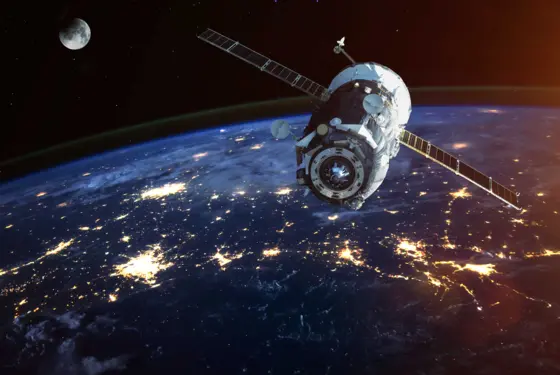
EN 9100 (AS9100) certification
What is meant by a certification according to EN 9100 (AS9100)? What is the purpose of an EN 9100 (AS9100) certification and what are the benefits?

High-temperature accelerometer
What is a high-temperature accelerometer? How does a high-temperature accelerometer work?

Modal analysis
What is and what purpose does modal analysis serve? How does it function and what physical parameters are thereby determined?
Need a consultation?
Our experts are just a click away.


