
The artificial term “Mechatronics”, invented by a Japanese engineer around the year 1970, stands for a genuine connection between mechanical engineering, electronics and, as a later addition, information technology. Mechatronic solutions are key in many applications and often require cooperation of different departments, for example in sectors such as automotive, aerospace, robotics or, as in the following case, machining: HSD Mechatronics develops mechatronic components for machine tools, e.g.: electrospindles, bi-rotary milling heads and further advanced machine tool systems. With about 300 employees, four subsidiaries (USA, Germany, Korea, China) and a network of sales and support centers, HSD is part of the listed Biesse S.p.A. company, an Italian specialist for machine tools with a global workforce of 4,100 people. Biesse and HSD are especially known for their multi-material approach, delivering solutions not only for machining of metal but also alloys, composites, wood, glass and stone.
HSD Mechatronics advances electrospindle development for machine tools with Kistler dynamometer
Driven by a dynamometer from Kistler, test and development engineers at HSD Mechatronics can systematically advance machine tool components such as electrospindles and milling heads, for example. The exact measurement results of cutting forces and torques allow for a better understanding of operating dynamics and enable innovations in tool development, especially in the direction of multi-materiality.
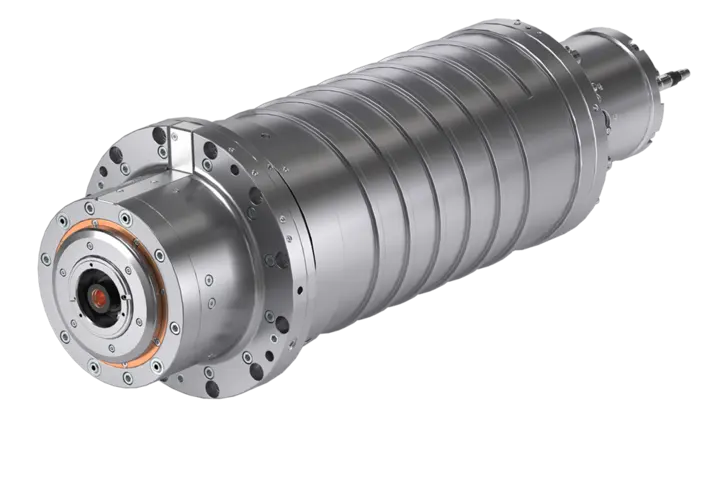


Advanced machining through high-class machine tool components
At the HSD Mechatronics headquarters in Pesaro, Italy, Manuel Camperchioli and his team play a key role in innovation by being responsible for testing and validation of prototypes. Camperchioli has been working at HSD since 2016 and holds the position of Prototypes, Tests and Experiences Manager: “We are responsible for proposing product performance improvements and exploring possible new applications,” he reports. “Through systematic testing in cooperation with suppliers and customers, we foster innovation as well as product development and refinement. In this way, we help our customers to deliver machine tools with high accuracy and high reliability, low TCO (total cost of ownership) and high OEE (overall equipment efficiency).”
As a response to fast-changing market needs and challenging technological requirements in machine tool development, HSD strongly focuses on state-of-the-art design methods and the best possible testing equipment. In the process of advancing their know-how and expertise, HSD started a collaboration with the measurement technology experts from Kistler in 2019: A 9255C dynamometer was purchased to support HSD with knowledge about actual cutting forces as a basis for design and validation processes. After an initial phase with training and support from Kistler, HSD started using the 9255C dynamometer on a regular basis from 2020 on – namely for the development of their ES1000 series of electrospindles. Camperchioli again: “The exact measurements help us to avoid both over- and under-dimensioning of these components. They allow our mechanical engineers to accurately design the spindles and to FEM-simulate their behavior, identifying precise process parameters and limitations.” Customers from HSD benefit from ideal pairings between their machine tools and HSD components, optimized work cycles and a virtually in-built damage prevention – because the specific process limits during machining are exactly known.
Dynamometers deliver best-in-class cutting force measurements
Stationary and rotating dynamometers from Kistler are widely used in machining R&D. Their key benefits:
- Very accurate measurement of dynamic forces and torques
- Great variety of machining applications such as milling, grinding, turning, honing, drilling, screw tapping, etc.
- Robust and reliable as well as coolant and lubricant resistant
- Available sizes and measuring ranges from micro- to heavy machining
- Very long service lifetimes
Depending on the chosen solution, a variety of signal conditioning, data acquisition and evaluation devices and software is available to complete a tailor-made measuring chain.
Dynamometer measurements boost milling head and electrospindle development
The 9255C dynamometer – with a top plate of 260x260 mm and a wide measuring range from –10 to 60 kN – is a multi-component piezoelectric measurement platform which allows to exactly measure all forces (Fx, Fy, Fz) and thus enables calculation of the moments (Mx, My, Mz) in the three perpendicular axes. Thanks to its high natural frequency and high resolution, the dynamometer can capture smallest dynamic changes in large forces to be measured.
The measuring chain at HSD is completed with the LabAmp 5167A high-end laboratory charge amplifier with integrated data acquisition system (DAQ) and the Dynoware software from Kistler for machining applications. “The instrumentation has enabled us to test our new ES1000 electrospindle in a complete way: We performed milling and finishing tests by measuring required cutting forces, torques and frequency spectra of various machining operations with different tools and materials. As a result, we were not only able to stress the electrospindle to the maximum, but also to FEM-simulate its dynamic behavior more accurately, including an estimation of the bearings’ service life,” Camperchioli adds.
Optimized tool development and assembly – enabled by Kistler measurement technology
Apart from the dynamometer measuring chain, HSD has also been employing load cells (both piezoelectric and strain gauge) in manufacturing. In combination with handheld devices from Kistler – portable multi-purpose solutions for measuring chain testing –, these load cells such as 9323AA and 4576A contribute to assembly optimization, for example by measuring the preload of bearings used at HSD. “Thanks to the accurate measurements, we were able to reduce the assembly lead time in our production,” Camperchioli reports.
HSD Mechatronics is continually working on machine tool components in order to complete its multi-material portfolio. The 9255C dynamometer from Kistler has well contributed to the company’s knowledge on product design and development processes for machining applications. Camperchioli adds: “We use it all the time to create new opportunities for innovation or to validate new product applications. The quality of the measurements and the robustness of the system are great, and we got tremendous support by Buelent Tasdelen and Michele Segato in the initial phase and since then.”
Co-innovation set to continue with new brake bench and wireless RCD
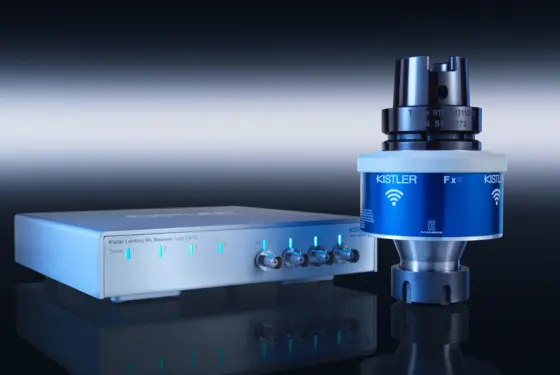
For the future, HSD is planning to install a new brake bench for testing purposes. For this reason, they are interested in a high-speed torque transducer from the KiTorq series. These rotor-stator units enable contactless measurements of torques at very high rotation speeds of up to 50.000 RPM. And on the dynamometer side, the innovative Wireless RCD (rotating cutting dynamometer) from Kistler would be a great add-on for customer visits as it is much easier to transport and operate somewhere else than a stationary dynamometer platform such as 9255C. As Camperchioli sums up: “Kistler solutions are especially valuable to a company like ours, as they allow us to deeply understand the operating dynamics of our products. And even more importantly: Based on the results we can guide our customers in making the best choice for their machine tool and machining application.”
![[object Object]](https://kistler.cdn.celum.cloud/SAPCommerce_Document_Preview/962-134e.webp "To measure is to know: A machining use case")