
Rockets are complex and expensive assets undergoing a lot of stress, especially during launch. So their engines have to be thoroughly tested to meet demanding requirements. Dependent on the nature of the propellant (solid or liquid) thrust, pressure and vibration characterization are indispensable test requirements for safe and efficient rocket launches. Kistler has more than 50 years of experience in space testing and supports engineers with cutting-edge, application specific measurement technology. Rely on us to make it fly!
Rocket engine testing

Precise measurement of thrust, pressure, and vibration under extreme conditions.
Up to 750 Hz
High-frequency dynamic force measurementUp to 700 °C
Dynamic pressure measurement directly in the combustion chamber: with high-temperature sensors (operational 1000 °C for short duration)Cryogenic
Dynamic characterization of liquid propellant fuel supply with piezoelectric pressure and acceleration sensorsLong-term measurement
of static pressure with piezoresistive pressure sensorsHigh natural frequency
We provide force sensors with natural frequencies >50 kHz for highly dynamic measurements.Rangeability
PE sensor technology allows for quasi-static and dynamic force measurements with high resolution.Adaptability
Single and multicomponent force sensors from Kistler can be combined to application specific dynamometers.Frequency response
Long-term static pressure measurement requires piezoresistive technology with inherent operation from 0Hz up to 5 kHz, unlike piezoelectric sensors which only allow quasistatic operation.Intrinsic safety
Depending on the use and installation of the pressure sensor, inherent protection against igniting explosive environments may be required.Long-term stability
Piezoresistive pressure sensors utilize an oil-filled and cavity etched, micro-machined, silicon sensing element which provides inherent 0.1%/year long-term stability.Ultra-high-temperature accelerometers
Sensors can be mounted close to the combustion chamber and are the preferred choice for optimized combustion instability measurement. In such applications, temperatures can reach up to 550 °C (930 °F).Cryogenic accelerometers and pressure sensors
The cryogenic piezoelectric accelerometers and pressure sensors span an outstanding temperature range down to -196 °C (-320 °F).High-pressure sensors for ignition
While measuring during the ignition phase, highly dynamic high pressure sensors will detect high pressure peaks, very high and fast rising thermal shock events with very harsh sensor diaphragm exposure.Featured products

Handheld charge amplifier and transmitter monitor
Data recording, insulation testing and quality assurance – the easy way
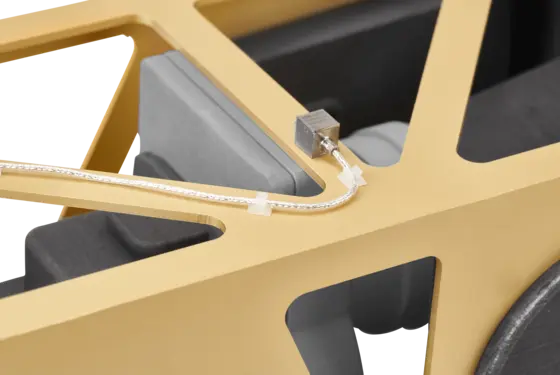
KiVibe Miniature triaxial IEPE accelerometer
The perfect fit for vibration measurements on lightweight structures and in tight spaces
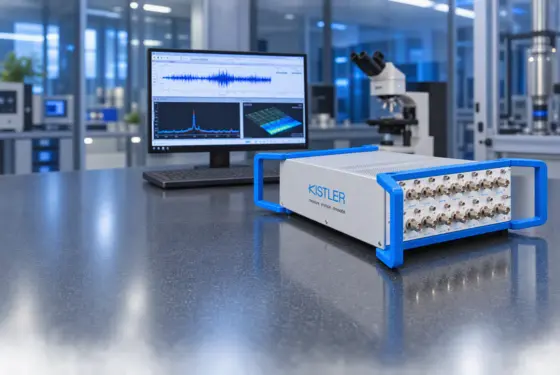
KiBox Lab 5280A – Multi-channel charge amplifier and DAQ
High-end signal conditioning and data acquisition for demanding application
Learn more in our glossary

EN 9100 (AS9100) certification
What is meant by a certification according to EN 9100 (AS9100)? What is the purpose of an EN 9100 (AS9100) certification and what are the benefits?

High-temperature accelerometer
What is a high-temperature accelerometer? How does a high-temperature accelerometer work?

Modal analysis
What is and what purpose does modal analysis serve? How does it function and what physical parameters are thereby determined?
Need a consultation?
Our experts are just a click away.


