Impact loading tests benefit from piezoelectric force sensors
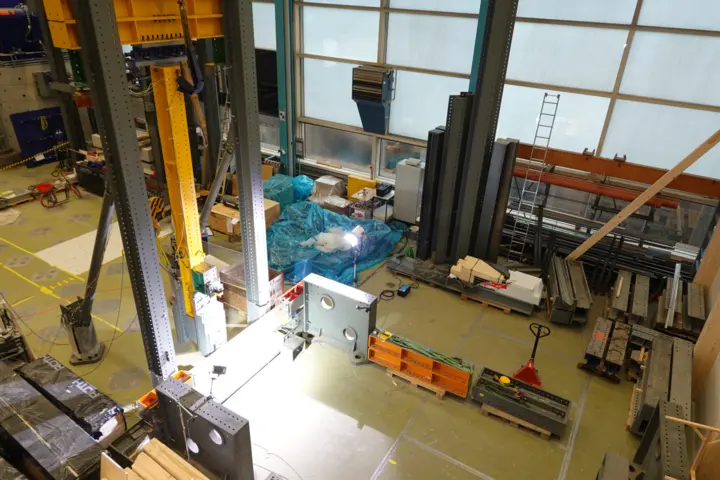
Alex Sixie Cao, who is originally from Norway, is researching into the robustness of timber structures as part of his PhD studies. “The goal of robustness research on timber structures is to gain a better understanding of how buildings behave when they are subjected to unforeseen and extreme load events – for example, in case of accidents, explosions, material degradation, impact loading, and more,” he reports. From 2021 to 2023, a series of impact loading tests on glued laminated timber (GLT) was completed with the help of force sensors and additional measurement technology from Kistler. These tests were conducted at the Institute’s Structural Engineering Lab, a medium-sized warehouse containing the setup with a large pendulum impact hammer and timber beams in a three-point impact bending configuration.
“We started out with an energy-based approach, calculating the impact parameters from the kinetic energy loss of the hammer passing through the beams.”The pendulum hammer, with a length of 4.65 meters and a mass of almost 3.5 metric tons, was equipped with an angular encoder, high-speed cameras and two different accelerometers from Kistler. “They worked perfectly well but from a theoretical point of view, we weren’t able to get all the results we wanted,” Cao continues. “That’s why we decided to extend our setup with force sensors from Kistler to measure the impact forces directly. Compared to products from other providers, these sensors are small; they come with a high natural frequency, and the measuring solution they provide is more robust.”
Eight piezoelectric force transducers of type 9051C were selected for their high stiffness, enabling precise measurements of highly dynamic events. In the current impact loading test setup, four of the Kistler force sensors are placed respectively at the left and right edges of the support system that holds the timber beam in position. They are installed in a rectangular layout below a plate in order to reduce any bending effects. The measurement chain is completed with the 5167A laboratory charge amplifier – commonly known as LabAmp – and the DynoWare software for data processing. The charge amplifier features a data acquisition rate of 100,000 samples per second (100 kSps) per channel, which is necessary due to the impact duration of only around 12 milliseconds, with a peak load of approximately 350 kN. “We’ve had tremendous support from Kistler with setting everything up correctly. They preloaded the sensors, helped us with the trigger for the force measurement, and assisted us throughout the entire process. As yet, we haven’t conducted many tests with the new setup (with force sensors) – but we’re already observing significant differences compared to the energy-based approach. It’s important to understand these differences between the two methods so that decisions are made on a solid scientific basis before they are incorporated into any of the norms and standards for timber buildings,” Cao explains.
Complete measuring chain – plus remote and onsite support
In total, over one hundred impact loading tests were conducted at ETH’s Chair of Timber Structures between 2021 and 2023. These included different kinds of wood – such as spruce and beech – as well as different types of timber: glued laminated timber (GLT) and laminated veneer lumber (LVL) for example, as well as timber beams with and without finger-joints. Results have shown significant differences between the energy-based and force-based approaches, which must be investigated further. Values currently in use for the dynamic strength increase of timber range between 1.0 and 1.2 based on blast-loading experiments. However, the current results from tests at ETH Zurich show a dynamic strength increase of 2.1 (reaction force approach) or 3.0 (energy approach). Nevertheless, it is too early to implement this finding in structural standards, and more research must be conducted to arrive at a better understanding. The load cells from Kistler allow a direct comparison of the impact loading tests at ETH Zurich with blast-loading tests at the University of Ottawa in Canada. The refinement of research methods achieved at ETH and other research centers worldwide delivers multiple benefits: it helps to make timber buildings better by improving efficiency and increasing robustness, and it may also play a valuable part in the conceptual design of protective structures made of timber such as rock fall barriers, highway barriers, and more.
Cao sums up: “We’ve made good progress with our impact loading tests, and we will definitely continue them in the future – possibly as a separate project. The solution from Kistler has made a good contribution to our results: the setup is very compact, and it has simpler requirements than similar technologies. We’re also very satisfied with the support from Kistler: they assisted us onsite and responded quickly whenever we needed them, and their approach to problem-solving really helped us to advance our testing routines.”



![[object Object]](https://kistler.cdn.celum.cloud/SAPCommerce_CMSTeaser_560x375/936-370.webp "[object Object]")
![[object Object]](https://kistler.cdn.celum.cloud/SAPCommerce_Document_Preview/961-973e.webp "ETH Zurich researchers opt for Kistler sensors for impact loading tests")