Modular automation solution for greater flexibility in the production of high-variety components
“Our solution consisted of a modular assembly line based on a longitudinal transfer system,” explains Andreas Nowak, CEO of TEAM Automation Berlin GmbH. All components are automatically fed into the line, assembled, inspected, and finally packaged. The movements of all workpiece carriers are synchronized in fixed cycles. Each individual assembly step is designed to flexibly accommodate different product variants. Mathematically, this results in several thousand variants that the system can produce fully automatically. It is even possible to process up to two product variants in parallel without interrupting the production flow. “A key factor in our solution’s success is the reliability of the individual components responsible for feeding, assembly, and packaging. That’s why we rely on partners who stand for quality and durability,” reveals Andreas Nowak.
Complex automation of the joining process – possible with strong partners only
To ensure that TEAM Automation Berlin can successfully carry out such challenging projects, the engineering company has built up a network of reliable partners. This includes Kistler. At its facility in Lorch (southwestern Germany), the company develops and manufactures electromechanical door solutions for demanding applications. The SKF production line had specific requirements for the joining process – since this step, too, needs to accommodate different variants. At the end of the assembly process, the lubricant distributors are either screwed shut or sealed by pressing in a disc. Depending on the product variant, the discs to be joined vary in size and thickness, and some are even made of different materials. Kistler’s electromechanical joining modules, which can be controlled continuously, provide the necessary flexibility.
Force-displacement-monitored press-fitting with short cycle times
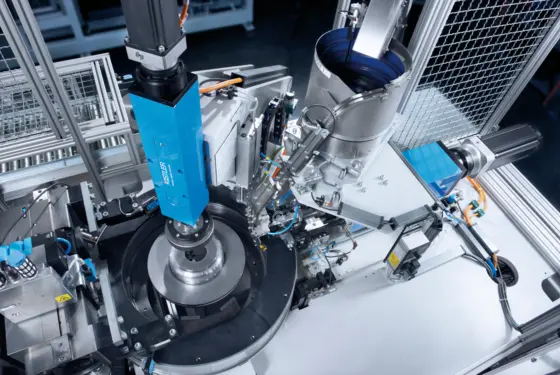
For the joining process itself, the system feeds the discs individually via a common feeder and moves them into the pressing position. This process step must be precisely synchronized with the movement of the workpiece carrier, as the next disc is already being positioned during the joining process. This highly dynamic sequence is made possible by the joining technology used. The module moves into position at high speed, performs the pressing operation with precision, and executes an equally rapid retraction – all within a cycle time of approximately five seconds. The electromechanical technology of the NCFE joining module also saves energy compared to pneumatic or hydraulic alternatives.
The joining process is monitored by the servo press’s integrated force-displacement monitoring system and by Kistler’s maXYmos NC process monitoring system, which evaluates each joining and press-fitting operation and documents and analyzes the XY curves based on the measurements. Using defined measurement windows (evaluation objects), the joining process can be precisely monitored and carried out with the highest repeatability. The system control automatically adapts the joining process to the specific requirements of the various product variants without the need for mechanical adjustments. As a result, the press-fitting process integrates seamlessly into the overall process optimizing both quality and cycle time instead of becoming a bottleneck. “We are already very familiar with Kistler’s joining technology from previous projects. We chose the NCFE joining module specifically for its cost-effectiveness in terms of reducing operating costs and scrap, its speed, and also for the durability that is typical for Kistler products,” said Andreas Nowak.
Success through close collaboration
“Electromechanical joining technology, with all its advantages, is of course the foundation. In addition, we have found a reliable partner on equal footing in Kistler, who understands our needs and responds quickly to unforeseen challenges. Our long-standing experience in joint projects and the short decision-making processes have been instrumental for us to meet the demanding time frame and process requirements,” explains Andreas Nowak. Especially when it comes to complex custom machines with a wide range of variants, it becomes clear that reliability and mutual understanding throughout the project are just as important as the performance of the components used. “The assembly line was a success not only for us, but our customer SKF was also very satisfied.”