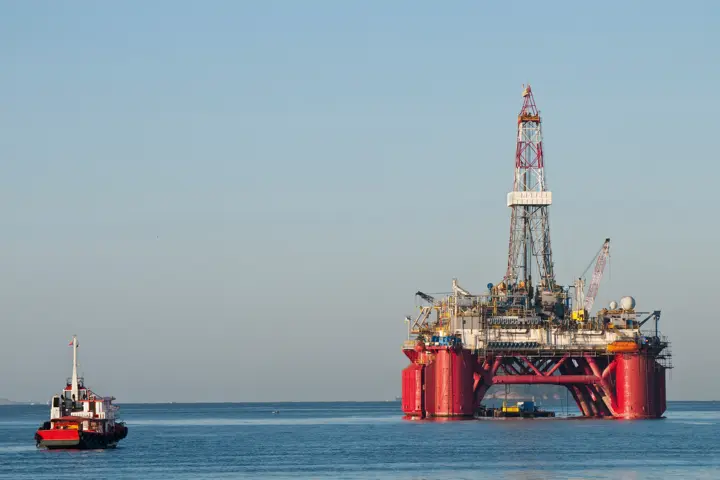
The development of subsea oil fields requires the location and drilling of wells deep beneath the seabed, followed by the extraction of oil and natural gas deposits via a network of subsea infrastructure. To maintain pressure in aging or mature reservoirs and maximize oil recovery, water is injected back into the formation. High-performance centrifugal pumps play a central role in this water injection process: they must deliver large volumes of seawater or treated injection water, transported at very high pressure from surface or subsea facilities down through injection wells. High pressures and capacities are required to overcome hydrostatic pressures at depth as well as resistance in the piping and the formation so water can reach the target zones with sufficient force to displace oil. In summary, water injection enables offshore oil production, and cutting-edge water injection pumps that maintain reservoir pressure are key to economically viable oil production from deep subsea oil fields.
Sulzer optimizes its high-energy centrifugal pumps with pressure sensors from Kistler
The oil and gas industry places extremely high demands on pumps, both for extraction and crude oil shipping. One particularly demanding application is the undersea extraction of petroleum. Here, powerful water injection pumps are indispensable. The high-performance pumps from Sulzer are equipped to meet these requirements and play an important role in water injection and crude oil shipping. Sulzer’s latest-generation HPcp centrifugal pumps reaches record-breaking pressures of up to 1,100 bar (16,000 psi). During its development and testing, Sulzer relied on Kistler's 603C piezoelectric pressure sensors. These sensors provide a deep understanding of the flow processes inside the pump, thereby forming the basis for optimizing the efficiency and reliability of the pumps.


Successful development of cutting-edge centrifugal pumps
Sulzer AG is a leading global provider of the equipment required for these applications in the oil and gas industry. This publicly listed corporation was founded in 1834 in Winterthur (Switzerland), where it is still headquartered today. With its three divisions – Flow, Services and Chemtech – Sulzer operates a network of 160 facilities in 45 countries with a total workforce of 13,500 employees, generating annual revenue of more than CHF 3.5 billion in 2024.
High-energy centrifugal pumps from Sulzer have set new benchmarks for pressure and capacity. These barrel casing pumps reach a peak pressure of 1,100 bar and offer maximum capacity of 4,500 m³/h, with rotational speeds of up to 8,850 rpm. Sulzer called on support from Kistler, the global market leader in dynamic measurement technology, to design and engineer the new generation of its HPcp series. The two companies can look back on decades of successful collaboration: after all, they are practically neighbors in Winterthur’s industrial district. Arrigo Beretta, Head of Products, Technology and Digitalization (PTD) in Sulzer’s Flow division, takes up the story: “Our clients come with high requirements – not only for the performance of the centrifugal pumps as such, but also for their energy efficiency and reliability over a wide operating range. Measurement technology from Kistler helps us to gain a deep understanding of the flow phenomena inside the pump – giving us the basis for holistic performance optimization.”
32 pressure sensors measure pressure pulsations in the fluid
Although simulation plays a key role in the pump design process, physical testing is still an integral element of product development and validation. For this purpose, Sulzer operates a state-of-the-art pump development test bed at its facilities in Oberwinterthur. Antonio Morisco has been with the company for 24 years, including ten years at the test bed, and he is responsible for all testing procedures here together with two colleagues. He reports: “For the HPcp tests, we worked with a two-stage model machine consisting of an impeller and a diffuser with seven channels. In this setup, we applied 24 IEPE pressure transducers (603C) in combination with eight 7031 pressure sensors, also from Kistler.”
Installation of the measurement technology was challenging, because it had to be flush-mounted in the impeller inlet as well as at the entrance and exit of the diffuser channels. These locations have diameters in the range of a few centimeters, so they require compact and robust sensors that have minimal impact on the measured quantities. Also, high measurement resolution is required to accurately capture transient phenomena such as (unwanted) pressure pulsations.
Pressure pulsations are deviations in fluid pressure caused by pump characteristics and operation. They can cause vibrations, noise, wear and even damage to pump components and pipelines. Countermeasures and design modifications are required to reduce the unwanted effects of pressure pulsations. It is exceptionally challenging to measure pressure pulsations in fluids due to their highly dynamic and transient nature. Suitable piezoelectric pressure sensors such as the 603C series from Kistler come with high natural frequencies, short rise times, and integrated acceleration compensation. Thanks to these attributes, they can even perform high-resolution measurements of small pressure fluctuations that are superimposed on high static pressures.
Pump design and development: a successful partnership
Morisco continues: “We run pump tests at different pressure levels and speeds, and we continuously measure pressure pulsations and vibrations in a closed loop. With this approach, we gain a deep understanding of the flow pattern – especially at part loads. We can then compare the results to the simulation, and that leads to adaptations in an iterative process to optimize the pump’s geometry.” As well as outstanding performance, today’s customers demand high operational flexibility including optimization at every operaiting point – resulting in maximum efficiency and reliability.
It took around six months to design, manufacture and commission the test rig and pump under investigation. The ultimate outcome: product qualification was completed successfully, paving the way for a new generation of market-leading centrifugal pumps with previously unseen performance. “When I started working at Sulzer more than 20 years ago, we had pumps with a pressure of 500 bar – and that was practically the world record at the time. With the new HPcp, we’ve more than doubled that performance! Although we’re slowly but surely approaching some physical boundaries, our development work is not coming to an end,” Morisco concludes.