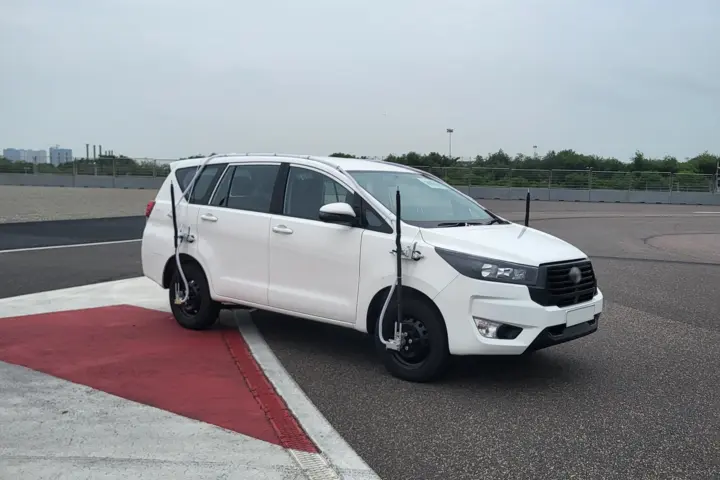
To meet these requirements, Kistler delivered a complete sensor-to-cloud road quality assessment system together with RTDT Laboratories AG – a spin-off of ETH Zurich. This technology integrates advanced in-vehicle measurements, local data processing, cloud analytics, and visual reporting.
Mounted on test vehicles, the measuring system for road surface quality inspection uses high-dynamic acceleration sensors and HF-series laser height sensors to measure the road surface profile with high precision and spatial resolution. The HF sensors use optical triangulation with a red laser to deliver non-contact height measurements. Optoelectronic speed sensors, such as the Correvit S-Motion, are combined with inertial measurement units to capture synchronized movement and positioning data across each section of the roadway. These sensors provide low signal delay and integrate GPS and accelerometers to deliver reliable positional and dynamic data for each road segment.
Edge computing modules then pre-process this data locally, minimize latency and reduce bandwidth before securely transmitting it to the Kistler Cloud. The cloud-based analytics, developed by RTDT evaluate the raw data using domain-specific algorithms. This includes calculating the roughness of a road surface using the International Roughness Index (IRI) as well as assessing ride comfort and vibration in accordance with ISO 2631.
All results are made available through an interactive, map-based dashboard. Contractors, supervisors, and authorities can use the dashboard to visualize road quality per lane and per 100m road segment, providing actionable insights in near real time.
While the core technology was developed in Switzerland through collaborations with ETH Zurich and RTDT Laboratories, the rollout and local adaptation of the system are managed by Kistler Instruments India Pvt. Ltd. in close coordination with local infrastructure authorities. On the Swiss side, Kistler’s Innovation Lab – a unit specializing in smart services that transform measurement data into practical applications – coordinated Kistler’s contributions to the project. Working closely together, all partners completed the full implementation in just three months, bringing together technical innovations from multiple domains and making the project both a logistical success and an architectural milestone.
The result: early detection of road surface quality instead of expensive rework
Road surface quality deviations and vibration levels are objectively tracked and documented to help enforce safety standards and optimize construction quality at every stage. This proactive approach reduces long-term maintenance costs, ensures full traceability, and remains valuable once the road is operational. With continuous monitoring, infrastructure managers can track surface degradation, detect emerging issues early, and schedule predictive maintenance. This helps preserve ride quality, uphold safety standards, and extend the road’s lifespan.
After its successful implementation on the Ganga Expressway, the end-to-end sensor solution for road surface quality assessment from Kistler is now being deployed on other major India expressways, including the Gorakhpur Link Expressway, Agra-Lucknow Expressway, Purvanchal Expressway, and Bundelkhand Expressway.