Kistler - sensors for pressure, force, acceleration and torque
    Piezoelectric and piezoresistive sensors
 
crosshair left
crosshair right
Piezoelectric and piezoresistive sensors
 
 
Measuretape


Choose your country:

The Force Sensor

English | Deutsch | Français | 中文 | Русский
Europe
Americas
Asia
Other
spacer

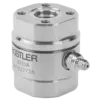
A force sensor generally measures the applied force from the proportional deformation of a spring element: the larger the force, the more this element deforms. However, the frequency range of this type of sensor is limited by this element having to be sufficiently elastic to undergo large-amplitude deflections reflecting the load.

To overcome this limitation, almost every Kistler force sensor relies on the piezoelectric principle exhibited by quartz. Under load, quartz crystals produce an electric charge proportional to the mechanical load applied: the higher the load, the higher the charge. Thus, in piezoelectric force sensors, quartz serves as both the spring element and the measurement transducer.

Thanks to the high rigidity of the crystal, the measuring deflections are very small, usually just a few microns. Where slow, quasi-static processes are being measured, this virtual absence of displacement keeps measurement error to an absolute minimum . Yet quartz also offers unrivalled accuracy in the case of much faster processes.

The quartz crystal converts each physical quantity to be measured (force, pressure or acceleration) into an output signal that is precisely linear and hysteresis-free. A quartz force sensor consequently has an extremely wide measuring range while remaining compact, robust and highly sensitive.

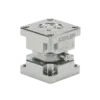
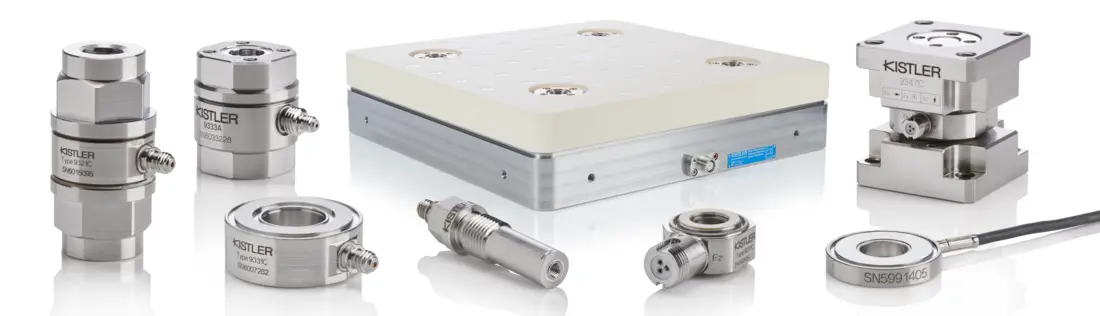
Single-Component Force Sensor

This force sensor is normally annular and consists of pressure-sensitive quartz washers sandwiched between two steel rings.

Three-Component Force Sensor

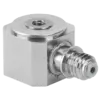
This force sensor with two shear-sensitive quartz washers (Fx and Fy) and one pressure-sensitive quartz washer (Fz) is particularly compact.

Torque Sensor

The shear-sensitive quartz disks of this type of sensor are arranged with their axes tangential to a circle. The torque sensor is mounted under preload.

Typical Force Sensor Applications:

  • Quality assurance in manufacturing and assembly
  • Monitoring of presses
  • Measurement of cutting forces involved in machining
  • Biomechanics
  • Product testing
  • Materials testing
  • Dynamic weighing of moving vehicles
  • Wheel force measurement

spacer
 
crosshair left crosshair right Print | Disclaimer | Webmaster | e-Contact | +41 52 224 11 11
 
acceleration sensor, torque sensor, force sensor, pressure sensor
spacer